Showing posts with label Andrew J. Young. Show all posts

Thursday, July 5, 2012

To Keep or Not to Keep: What's Really in the Archives

Andrew J. Young Papers, AARL Archives Division

You never really know what you might find in the archives. This is part of the excitement- both for a researcher looking at a collection for the first time, but also for the archivist processing the collection before it is open to the public. Researchers hope for that special something that will help strengthen their thesis or that document they weren’t expecting that might set their work apart from other previous work. It is not the job of the archivist to interpret documents for future researchers, but, in deciding what to keep and what not to keep- what we call appraisal- it is important to consider what kinds of questions future researchers might be interested in. In Gregory S. Hunter’s Developing and Maintaining Practical Archives, Hunter argues that “the archivist must be aware of current research trends and interests, using this information to extrapolate what may be of interest to future researchers. This is a weighty responsibility” (Hunter, 52).

This responsibility is one that archivists at Auburn Avenue Research Library, like all archival repositories, take very seriously. When donors give collections to a repository, they typically sign a deed of gift agreement that lays out the guidelines for the collection. Donor agreements vary widely- some donors give archives free reign to open anything found in the collection to the public. Other agreements may specify that any sensitive information, such as documents containing personal information, remain closed for a period of time. These agreements are necessary because donors are entrusting our archives with their papers- whether they are family or individual papers, or their life’s work. Often, even if a person is donating his/her own papers, one may not realize everything that it is in the collection. Some collections are so large and, in the case of politicians or business collections that have been handled by many people, the donor may not realize that someone’s family photos or birthday cards or cigarette cartons, may be hiding in a box. In these cases, the archivist may refer to the deed of gift agreement for clarification, or, in the case of the cigarette carton or candy wrapper, simply discard it; unless the carton is very old and in good enough condition that it might make an interesting exhibit piece. You can see where this gets complicated, even with items that might seem like everyday trash.

Of course, there are times when an archivist may find documents of greater concern, either because of privacy issues or because the document’s potential research value is outweighed by its salacious nature. Medical records, adoption records, and disturbing or violent photos are just a few examples- in these cases, archivists would close or destroy the items to protect the parties involved. If the donor is still alive, the archivist may even return the items in question.

As Hunter said, appraisal is a “weighty responsibility” indeed. Every repository is constrained by space and storage concerns and even if we want to, we just can’t keep everything. That is why archivists at AARL spend a great deal of time processing collections, thinking about what visiting researchers might be interested in, and doing our very best to honor those whose papers we’ve collected.

Developing and Maintaining Practical Archives: A How-to-do-it-Manual. 2nd edition. Gregory S. Hunter. New York: Neal-Schuman Publishers, Inc. 2003.

Jessica Perkins-Smith, LSU MLIS graduate student, AARL Archives Intern

Wednesday, March 9, 2011

Open for Research: Andrew J. Young Papers + Jean Childs Young Papers


On Sunday, March 06, the Auburn Avenue Research Library celebrated the opening of the Andrew J. Young Papers, as well as those of his first wife Jean Childs Young.  Close to 400 people attended the event, which included a conversation between Ambassador Andrew Young and the Honorable Kasim Reed, Mayor of the City of Atlanta, a display of rare and unique items from the collection, and a catered reception.  It also received widespread media coverage. You can view the event here, listen to a report here, and read about it here, here, here, and here. 

AARL's Adiministrator Francine Henderson, Archivist Kerrie Cotten Williams, and Project Archivist Cheryl Oestreicher were part of the program.  Each spoke eloquently about the importance of public libraries, research libraries, and archives. For Oestreicher, it was an occassion to highlight the experience of working closely with Young's papers. You can read her address below.

 
Comments for Andrew Young Event - .

If you are interested in perusing the finding aids, visit our online finding aids here.

Next up for Oestreicher and team is the Atlanta Chapter of the NAACP records.  Stay tuned.


Posted by Wesley Chenault, Library Research Associate

Thursday, January 20, 2011

The Opening of the Andrew J. Young Papers

SAVE THE DATE!

On Sunday, March 6, the Auburn Avenue Research Library will host an event to celebrate the opening of the Andrew J. Young Papers.

In 2009, the archives received a grant from the Council on Library and Information Resources to process the collection. It documents the various aspects of his career and family life spanning more than 50 years, including his positions as a minister, civil rights activist, Congressman, Ambassador to the United Nations, Mayor of Atlanta, Co-Chair of the 1996 Atlanta Committee of the Olympic Games, and his involvement with Law Companies Group, Inc. and GoodWorks International.

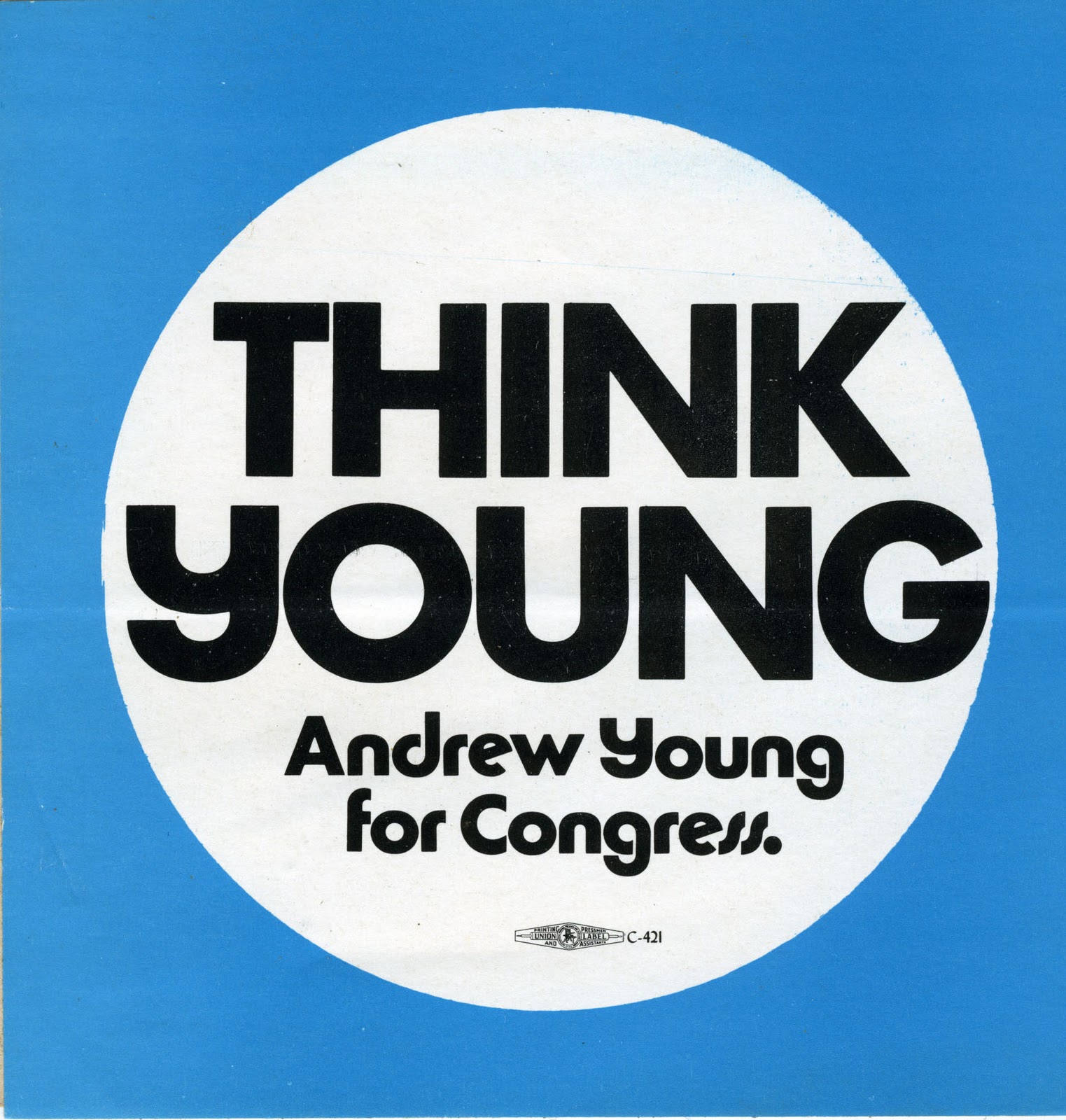
The collection contains correspondence, speeches, press releases, calendars, books, minutes, reports, publications, articles, photographs, artifacts, textiles, trophies and awards, artwork, posters, programs, invitations, campaign memorabilia, manuscripts, travel documents, notes, sermons, ephemera, and audio-visual material.

More details to come soon. We hope you can join us to celebrate this momentous occasion!

Posted by Cheryl Oestreicher, Project Archivist

Wednesday, December 8, 2010

Archives and Publics: Andrew J. Young + Photograph Identification

The Andrew J. Young Papers contain nearly 40,000 photographs and slides that document Young’s family, life, and work spanning more than 50 years. There are photos of Young, his children, and his grandchildren as babies; his first ministerial post in the mid-1950s through weddings he performed in the 1990s; the SCLC Citizenship School through his GoodWorks activities; his first Congressional campaign in 1970 through his 1990 gubernatorial campaign; his Ambassadorial trips across the globe through bidding for the Olympics through tropical vacations; and everything in between.  (Below: Ambassador Andrew Young is pictured in his Waldorf-Astoria residence, late 1970s.)


Many prominent people appear in the photographs, including Jimmy and Rosalynn Carter, RUN-DMC, Oprah Winfrey, Maya Angelou, Hank and Billye Aaron, Martin Luther and Coretta Scott King Jr., Jesse Jackson, Bill Cosby, Sidney Poitier, Garth Brooks, Harry Belafonte, Cornel West, Muhammad Ali, George Bush Jr. and Sr., Bill and Hillary Clinton, Mikhail Gorbachev, Billy Graham, Rosa Parks, Mother Theresa, Nelson Mandela, Desmond Tutu, and Ted Turner and Jane Fonda. There are also many prominent Atlantans, such as Shirley Franklin, Sue Ross, Julian Bond, Hosea Williams, Jesse Hill, Joseph Lowery, Ralph Abernathy, Marvin Arrington, Zell Miller, Benjamin E. Mays, Bernard Scott Lee, Bill Campbell, and Maynard Jackson. (Below: Andrew Young, seated, identifies photographs for project staff, pictured left to right, Brenda Tindal, Mike Kaiser, and Cheryl Oestreicher.)


While the majority of the photographs were labeled or identifiable, many were not. On Tuesday, Andrew Young and his daughter Andrea visited the archives and helped identify the people, places, and events. Their assistance was invaluable as it not only helps us to organize the images, but will ease researchers’ use of the collection. As we documented what they said, we listened to their reminiscences about the people, the places, the events, and their lives. (Below: Pictured left to right are Mike Kaiser, Cheryl Oestreicher, and Andrew Young.)


Near the end of his time in the archives, he reflected, “We’ve really had a good life.”

For more information about the grant-funded project to process the Young papers and other civil rights related collections, see the CLIR Hidden Collections Grant blog.

Posted by Cheryl Oestreicher, Project Archivist

[The Andrew J. Young Papers at AARL are closed for processing and expect to be open in March 2011]