Showing posts with label research. Show all posts

Tuesday, June 12, 2012

Documenting Sports: 100% Wrong Club of Atlanta


Mrs. Margaret Jacobs donated the historical records of the 100% Wrong Club to the Auburn Avenue Research Library. The majority of the records were collected by her late husband, Joseph H. Jacobs, a member of the club.  Established in 1934 by the Sports Department of the Atlanta Daily World, the club’s members surveyed college teams and athletes for recognition and awards. The club has expanded its scope by continuing to recognize and award college and high school athletes, local community leaders, and national pioneers in the field of sports and social justice. Each year, after the college bowl games, the club selects college and high school student athletes to attend the annual "Sports Jamboree" weekend. The collection includes photographs, minutes, news clippings, correspondence and ephemera.

The collection is now available for use:   http://aafa.galileo.usg.edu/aafa/view?docId=ead/aarl0011-007-ead.xml;query=wrong;brand=default

Posted by Kerrie Cotten Williams, Archivist and Manager of the AARL Archives Division

Thursday, September 1, 2011

AARL home to Amelia Boynton-Robinson papers

Left to right, Dick Gregory and Amelia Boynton-Robinson, Auburn Avenue Research Library, August 2011

The Auburn Avenue Research Library is now home to the Amelia Boynton-Robinson papers. At 100 years old, Mrs. Boynton-Robinson, pictured above right, is an activist/organizer, speaker, playwright and author. Born in Savannah, Georgia, she is the oldest living graduate of Tuskegee University. Mrs. Boynton-Robinson worked closely with civil rights leaders to plan and strategize rural and regional efforts. Her home in Selma, Alabama, was a meeting place for leaders during the 1960s, including Martin Luther King, Jr., Joan Baez, John Lewis, and Andrew Young. Mrs. Boynton-Robinson along with her husband, Samuel, organized Alabama residents in voting rights campaigns and civil rights activities. Mrs. Boynton-Robinson’s collection reflects her wide range of activities and includes, newspaper clippings, awards, letters, ephemera and photographs. The collection is approximately 8 cubic feet and will be open for research once processed. 

Posted by Kerrie Cotten Williams, Archivist

Monday, August 15, 2011

Donors as Advocates: Duncan E. Teague


I was doing a bit of housekeeping recently when I came across an overdue idea for a post -- donors as advocates. Earlier this year, February 11th-12th, readers may recall that AARL held a two day program to announce and celebrate the donation of the Duncan E. Teague collection, which includes the invitation pictured above. (Teague is a founding member of ADODI Muse.) On Saturday, February 12th, WABE aired Rose Scott's interview with Teague, who spoke about the importance of preserving the past, especially that of underrepresented communities.  Listen here.

While advocacy in the field is not a new topic, per say, it is one that remains relevant, especially in uncertain economic times. These days we all are expected to do more with less, and AARL is grateful to have the support of patrons and donors, like Duncan Teague, whose familial, social and professional networks reach far beyond the walls of the library.  

Two publications are listed below for those interested in reading about advocacy and archives.

References:

Finch, Elsie Freeman. Advocating Archives: An Introduction to Public Relations for Archivists. Chicago: Society of American Archivists and Scarecrow Press, Inc., 1994.

Hackman, Larry J., ed. Many Happy Returns: Advocacy and the Development of Archives. Chicago: Society of American Archivists, 2011.


Posted by Wesley Chenault, Library Research Associate

Tuesday, August 9, 2011

GHRAB Award: UGA's Dr. Barbara McCaskill and Christina L. Davis


Yesterday, I was informed that the Georgia Historical Records Advisory Board (GHRAB) selected Dr. Barbara McCaskill and Christina L. Davis's project “J. Richardson Jones: The Atom Bomb of Auburn Avenue” for a 2011 “Research Using the Holdings of an Archives” Award.

A statewide program, GHRAB awards exceptional efforts in archives and records work. To appreciate the scope and depth of their project, which included many research hours in AARL's Archives Division, read the 1-page description below. The poster pictured above, from the Atlanta Life Insurance Company Records, advertises one of Richardson's works, "Parade of Negro Progress."
   
 
Congratulations!
 
Posted by Wesley Chenault, Library Research Associate

Wednesday, June 29, 2011

“Yo Ho Ho and a Bottle of Rum!”


Disney’s latest film release in the Pirates of the Caribbean franchise continues a long standing fascination with pirates and images commonly associated with them – ships, parrots, scenes of debauchery, and the token bottle of rum. While piracy has a rich history, its ever present companion, rum, has a history that connects to colonization, slavery, and the appropriation of African and African American imagery in advertising, evidenced by rum bottle labels from the early twentieth century, part of AARL’s Ephemera collection.

While the Portuguese were the first to corner the market on the European slave trade in the 15th century, it was their Spanish neighbors who introduced African slaves to the Caribbean, or West Indies, at the beginning of the 16th century. During this period, Spanish and Portuguese colonists realized that the climate of the Caribbean proved ideal for sugarcane cultivation, leading to the development of sugar mills throughout the islands. As other European powers began to establish their presence in the Caribbean and North and South America, they too began to exploit imported Africans for slave labor.


According to the Trans-Atlanta Slave Trade Database, the exportation of sugar from the Eastern Caribbean began in 1641. The industry spread quickly to mainland Central and South America. After 1650, sugar had become “king” of the Caribbean, especially in the English, Dutch, and French colonies. The process of converting sugarcane into sugar produces multiple by-products, including cane juice and molasses. Islanders discovered that these products could be used to create crude, cheap liquor – rum. As the alcoholic beverage was refined, its popularity soared in both the New and Old Worlds. At the height of rum’s popularity in the 17th and 18th centuries, it was consumed by seafaring adventurers and common families in Colonial North America alike, and utilized as currency in the transatlantic slave trade. As slavery was abolished throughout the world in the 19th century, rum began its decline along with sugar production. However, the industry remained embedded in the Caribbean economy and consumer imagination.

The labels pictured here are from rum producers located in the Caribbean, with the majority originating from islands under French sovereignty. The featured labels come from rum production in the 1930s and 40s. Earlier product labels depicted sea or island images, including ships or beach scenes. A fascinating topic for further research and examination would be the period when advertisements in the industry shifted to images and stereotypes of people of African descent, a commercial practice that occurred in the United States during the same time period that the pictured rum labels were produced.


In American product advertising, the Aunt Jemima logo (before the 1989 make-over), which is based on the mammy archetype that developed in minstrel shows during the mid-1800s, is perhaps one of the most relatable examples. The archetypal mammy was usually dark skinned, overweight, large breasted and adorned with a head covering – the happy slave of romanticized plantation life born of the white imagination. Despite differences, these labels visually reference the mammy figure. The female characters wear headscarves or wraps, large loop earrings, are mostly darker in complexion, and are smiling. These depictions represent an exoticism and idealism of blackness, specifically female blackness, for white consumers. Like the Aunt Jemima image, those depicted in rum labels represent a historical moment shaped by racism, consumerism, and colonialism – a complex and troubled past documented in this post through ephemera.


(The rum labels that appear are currently unprocessed. For access, please contact the Archives Division. The books mentioned below, used for this post, are available for research at AARL.)

References:
Alderman, Clifford L. Rum, Slaves, and Molasses: The Story of New England’s Triangular Trade. Crowell-Collier Press, 1972.

Kern-Foxworth, Marilyn. Aunt Jemima, Uncle Ben and Rastus: Blacks in Advertising, Yesterday, Today and Tomorrow. Greenwood Press, 1994.

Manring, M.M. Slave In a Box: The Strange Career of Aunt Jemima. University of Virginia Press, 1998.

McElya, Micki. Clinging to Mammy: The Faithful Slave in Twentieth Century America. Harvard University Press, 2007.

Thompson, Barbara. Black Womanhood: Images, Icons and Ideologies of the African Body. University of Washington Press, 2008.

Wallace-Sanders, Kimberly. Mammy: A Century of Race, Gender, and Southern-Memory. University of Michigan Press, 2008.


Posted by Nicole Carmolingo, AARL Archives Intern

Wednesday, June 22, 2011

The Final Touches: Opening a Collection for Use


For an archivist, one of the most satisfying moments before a collection officially opens to researchers is affixing labels to boxes. In terms of the tasks associated with processing, there is no more to do. All arrangement and description is complete. All folders are labeled. All extraneous bits and boxes have a home. Everything is in its final place.

Pictured above, AARL Intern Nicole Carmolingo attaches the last label to the Shirlene Holmes papers, which opens soon, after final revisions are made to the finding aid. Details about the collection will accompany the announcement posted here. For now, Nicole has a deserved happy moment for processing, arranging, and describing 35.19 linear feet of materials comprising 50 boxes and 5 oversize boxes.

Posted by Wesley Chenault, Library Research Associate

Saturday, June 18, 2011

YouTube and Outreach

Thanks to Nicole Carmolingo and Jessica Epstein, two amazing interns at AARL, the Research Library is increasing its Web presence via YouTube.  Take a look.


Posted by Wesley Chenault, Library Research Associate

Monday, May 23, 2011

Digital Tools for Archives: Movies and Music and Comics...Oh My!

Nicole Carmolingo, AARL intern, was at a recent Society of Georgia Archivists workshop called "Technology for Advocacy and Outreach: A Bootcamp for Archivists Going Digital." The seminar was held Saturday, May 14, on campus at the University of West Georgia. In one day, participants created both a web comic and a video relating to part of their institutional collections. Nicole chose to focus her creations on Henry Rutherford Butler.

Henry Rutherford Butler lived from 1862-1931, attended medical school and became one of the first African American physicians to open a practice in Atlanta. Butler and his wife were highly active in both Atlanta and national African American organizations, both as members and founders. The Selena Sloan Butler papers, held by the AARL, contain valuable material about Butler, his wife and their son, as well as life in Atlanta in this era.

As you can see, Nicole used Comic Life and Moviemaker, two open source media programs, to create the content above and below. We hope you enjoy learning a little more about Butler's life. You can click here to link to the AARL finding aid for the Selena Sloan Butler Collection. We would love to hear from you about whether you would like to see more video and comic strip content from us.


Posted by Jessica Epstein, AARL Archives Intern

Thursday, April 28, 2011

From Tuskegee to Tokyo

Selena Sloan Butler family papers, Archives Division, AARL
During a review of scans of the Selena Sloan Butler family papers, one of the eleven collections being digitized for the NHPRC funded collaborative with the Digital Library of Georgia, I was struck by images from an album of postcards. From 1902 to 1908, Butler kept postcards from friends and colleagues travelling for business as well as leisure. They cover a broad geographic swath, from Tuskegee to Toronto to Tokyo, and shed light on the lives of an elite class of African Americans who navigated the constraints of the Jim Crow South. 

Selena Sloan Butler family papers, Archives Division, AARL
The postcards also represent events, places, and moments related to African American history in the United States. For example, in 1907 Butler received a postcard mailed from the Colored State Fair in Macon, Georgia, which documents segregation and the Georgia State Fair during the early twentieth century. Another from the same year contains an image of (Dr. J. T.) Wilson's Infirmary, a now-vanished hospital for African Americans in Nashville, Tennessee.  On September 05, 1906, Dr. Henry R. Butler, Selena's husband, received a postcard of Richmond, Virginia, from a colleague. At the end of month, a bloody race riot erupted near the Butler family's home in Atlanta, Georgia.


Posted by Wesley Chenault, Library Reseach Associate

Wednesday, April 20, 2011

Digitizing Historic African American Education Collections: Inventory


AARL and DLG serve diverse communities of library patrons including scholars, graduate and undergraduate students, educators, genealogists, and general users. The selected collections for this project represent varied and diverse voices that inform, expand and/or complicate existing historical narratives about African American education. Four of the eleven collections document the founding and development of black colleges and universities, the emergence of black professionals in education, the establishment of industrial and vocational schools, and the struggles to establish education in rural communities.

The Atlanta University Collection, bulking 1865 to 1955, contains materials that span its beginnings after the Civil War through its later incarnation as Clark Atlanta University (the consolidation of Clark College and Atlanta University), as well as materials about other current (Morehouse and Spelman Colleges, and Morehouse School of Medicine) and former members (Morris Brown College and the Interdenominational Theological Center) comprising the Atlanta University Center, the nation’s largest consortium of African American higher education, located in Atlanta, Georgia. Correspondence from the American Missionary Association and the Freedman’s Bureau highlight the founding and early development of the Atlanta College (later University) from 1865 through the 1870s and the school’s role in supplying teachers and librarians across the South. Also included are correspondence files from several early presidents of the University – Edmund A. Ware (1869-1885), Horace Bumstead (1888-1907), Edward T. Ware (1907-1922), Myron W. Adams (1922-1929), and John Hope (1929-1936) – and communications with the main Northern philanthropic organizations involved in funding African American colleges – the Jeanes Fund, the John F. Slater Fund, and the Phelps Stokes Fund.

The Adam Knight Spence and John Wesley Work Collection, 1851-1936, consists of materials related to music education, Fisk University, and the Fisk Jubilee Singers. Of particular interest is extensive correspondence (1888-1891) from Henrietta Matson, principal of the Akola Girls’ English School in Berar, India, to Elizabeth and Mary Spence regarding the area’s education and social conditions. Adam Knight Spence served in various capacities at Fisk University, which was founded by the American Missionary Association and the Freedman’s Bureau in 1865. John Wesley Work, Jr. was a leader in the movement to preserve, study, and perform Negro spirituals, and served as director for the internationally recognized Fisk Jubilee Singers. Both Spence’s and Work’s contributions to Fisk University and the community are well-documented in the collection.

The Samuel Howard Archer Collection spans from 1898 to 1941 and documents through correspondence, clippings, and printed material his relationship with scholars and administration at various colleges and vocational schools, among them Morehouse College, Spelman College, and the Tennessee Agricultural and Industrial State College (now Tennessee State University). After teaching in rural schools in Virginia, he was a professor of mathematics at Morehouse. Later, he served as president.

The Sanford Henry Lee Papers range from 1929 to 1955 and include correspondence, photographs, and printed material related to Lee’s work as an educator in Alabama and Georgia school systems. From 1929 to 1948, Lee served as a farm demonstration extension agent of Georgia. His role in providing education in rural parts of the South is documented in proclamations, awards, and certificates from the Fort Valley State University and Tuskegee University.

Two collections, the Auburn Branch Library Records and the Annie L. McPheeters Papers, illustrate the role of public libraries in the education of African American children and adults and community development. Bulking 1934 to 1954, photographs, programs, brochures, and correspondence document the educational and community activities of the Auburn and West Hunter Branches of the Atlanta Public Library (now AFPLS), whose historic core collections are housed at AARL.

Five collections document the development of elementary and secondary schools for African American youth, the contributions of black educators, and the connections between institutions of early and higher education to local communities. The Helen Adele Johnson Whiting Papers highlight Whiting’s pioneering work in the field of elementary progressive education and the education of African American children, mainly from 1929-1950, through correspondence to and from W. E. B. Du Bois; Ambrose Caliver, senior specialist in the education of Negroes, United States Office of Education; John Hope; and James Weldon Johnson. Printed material includes programs, announcements, and invitations pertaining to the National Conference on the Fundamental Problems in the Education of Negroes and the White House Conference on Child Health and Protection.

The Peyton Austin Allen Papers, bulking 1887-1889, document Allen’s role as an educator in Atlanta schools for African American youth, show his ties to Atlanta University, and highlight the contributions of Richard R. Wright and Booker T. Washington to the field of higher education.

The James Frank Harrison Family Collection documents the Harrison and Partridge families’ work in Atlanta public schools for African Americans and connections to Howard University and Haines Institute (later the Haines Normal and Industrial Institute) in Augusta, Georgia, mainly from 1922 to 1950. Included in this collection is a lengthy series of correspondence between James Harrison, Jr. and black philosopher Alain Locke, who was active in the Adult Education Movements in Harlem and Atlanta.

The William B. Matthews Papers, 1899-1925, document the activities of both Matthews and his wife, Josephine Ophelia Beale, in the field of education. Josephine was an accomplished teacher and William served two decades as principal of the Houston Street School in Atlanta. After 1910, he became principal of Central Colored High School in Louisville, Kentucky. Highlights include tintypes and albumen prints of black educators, schools and students; correspondence from Booker T. Washington; and letters to the top administration of several colleges and universities, among them Atlanta University, Fort Valley High and Industrial School, and Morris Brown College.

The Selena Sloan Butler Family Papers consist of correspondence and printed materials related to her work organizing the first National Congress of Colored Parents and Teachers and co-founding the National Congress of Parents and Teachers. Correspondence between family and friends documents the ties between black educators and various community organizations in Atlanta and across the nation. Of particular interest are the documents related to Booker T. Washington’s address to the 1895 Atlanta Cotton States and International Exposition.

Digitized collections breathe life into history and serve as testaments, both sweeping and intimate, to African American social and cultural experiences, which are national experiences. Providing these materials online will expand AARL’s institutional reach to those who may never come to Atlanta to gain access to these U.S. treasures.

Posted by Wesley Chenault, Library Research Associate

Thursday, April 7, 2011

Digitizing Historic African American Education Collections: Methods


Yesterday, Kerrie Cotten Williams and I met with Sheila McAlister and Mary Willoughby of the Digital Library of Georgia (DLG) to have them review the first batch of scans, close to 4,000, for quality control and feedback. We are relieved to report all is well and on track, thanks in part to the meticulous work of Colleen Carrington, who struck a balance between speed and excellence early on in the project.  Though we have 8 more collections to digitize, about 70,000 scans, we've settled into a comfortable pace for production. In an earlier post, we provided a summary of the scope and goals of the grant. (See here.) Today's entry focuses in depth on the project's methods.

For the digitization grant, collection and series selection was based on three criteria – subject, format and copyright. We identified 11 collections with folder and item level EAD-encoded finding aids, totaling 50 linear feet. Random files were selected from boxes and sampled to obtain an estimation of 74,000 pages. AARL owns the physical property of its collections through deeds of gift or sale. Of the material proposed for this project, 97% is either in public domain or AARL/A-FPLS owns intellectual copyright. Material whose copyright remains with original creators will not be digitized and is available for use onsite. AARL and DLG abide by current laws and regulations regarding copyright and fair use. Patrons must obtain permission from both institutions and the copyright holders, if any, to publish, broadcast, perform, or exhibit materials held in either repository. AARL and DLG provide robust reprographic services for patrons, though the onus of securing permission from copyright holders is the patron’s responsibility. Both institutions facilitate access to copyright holders when the information is known.

When completed, access to the digitized materials will be through the AARL finding aids database, DLG Web site, and via Web search engines. Since 2004, the DLG has presented folder and item level EAD-encoded finding aids of AARL’s holdings as part of a project of the Georgia HomePLACE initiative, supported with federal LSTA funds administered by the Institute of Museum and Library Services through the Georgia Public Library Service. AARL’s finding aids are discoverable through any major internet search engine. Furthermore, AARL creates MARC21 bibliographic records for archival collections in WorldCat that are downloaded into the institution’s local online catalog. DLG personnel will add digital archival object links to the EAD inventories for each digitized folder. In viewing the container list for a given collection, users will discover which folders are available online, as well as those available only at AARL. The finding aids also communicate the content, context, and structure of AARL’s collections.

For two years, AARL grant staff will scan, crop, and deskew content using flatbed scanner work stations and Adobe Photoshop. During this period, AARL and DLG personnel will review images for quality control. From the EAD files, the DLG will automatically generate folder-level Dublin Core records using a Perl script and metadata mapping/subject heading assignment protocol developed and tested in the 2007 NHPRC-funded Troup County (GA) Archives digitization project. (See project results here, specifically Series IV and V.) The DLG will load the Dublin Core records into its union metadata catalog (META), which will support access to the material both via the DLG site and Web search engines.

The project will proceed according to national standards and best practices for digital imaging and description. The finding aids are encoded using EAD version 2002 and adhere to best practices developed by the Research Libraries Group. The folder-level metadata records will use Dublin Core as the data structure. The DLG will employ the following content standards: AACR2, DACS, LCSH, LCNAF, AAT, and the local DLG name authority database. Master images will be 400 dpi, uncompressed TIF 6 images in 24-bit RGB color at 100% size. File-level access versions will be layered PDF, with DjVu as an alternate choice. DLG personnel will generate derivatives (PDF and DjVu files) for each folder of content for Web display; load master images to the DLG archival storage system for migration, disaster recovery, and other uses; load PDF and DjVu files to the DLG public Web server; and implement format selector pages.

Patron demand for AARL's archival collections has increased steadily since 2004, when we partnered with the DLG to create and host EAD records for our processed collections. Within the Archives Division, usage statistics capture the number of archives patrons inside and outside the library, as well as the collections requested and used. Between 2005 and 2009, there have been 4,448 patrons in AARL's Archives Division. During the same period there were 5,817 requests for archives and special collections. Also, staff has identified which collections have more frequent request and use. In particular, requests for and use of materials that document African American education, civil rights, and African American business have increased. Beginning in March 2009, the Archives Division began using Google Analytics to track Web site use by remote visitors, hoping to better identify the specific archival finding aids viewed by these users. Since implementing Google Analytics, staff has tracked use of archival finding aids that specifically represent the collections in this grant. Analysis of these statistics allows us to make better informed decisions about collection processing priorities and collection delivery methods, including digitization.

In future posts, we will address a summary of the collections, lessons learned, and project outcomes. Keep checking in, and please comment.
 
Posted by Wesley Chenault, Library Research Associate

Thursday, March 24, 2011

Archives and Publics: Dynamic Women = Relevant & Engaged Work


For visitors just finding the blog or regulars who may have forgotten, the Archives and Publics series is about connections between archives and various publics – scholars, interns, genealogists, students, documentary filmmakers, authors, artists, and others. The series highlights the ways in which different groups access and use archives with a focus on AARL's constituents.  Today, we have two features about faculty and graduate students from the University of Georgia and the University of West Georgia -- all dynamic women doing relevant and engaged work related to African American culture and history.  Another connection is that they've all conducted research in AARL's Archives Division.

In the past, we've included posts (here and here) from graduate students in the Public History program in the History Department at the University of West Georgia. Today, our first feature is UWG’s Dusty Marie Dye, who over a year ago visited AARL regarding a public history project about African American burial sites in Atlanta’s Oakland Cemetery.  In February of this year, her contributions to the project came to fruition when the Historic Oakland Foundation launched “African American Voices,” a cell phone walking tour and outdoor exhibition that interprets the cemetery's African American history; see the image above. You can read more about it here, and in the Spring 2011 issue of the Oakland Herald. See also UWG's Center for Public History's project on African American shape note singing, which Dye served on as a graduate research assistant.  

Next is an update on UGA's Dr. Barbara McCaskill, Christina L. Davis, and JoyEllen Freeman's research project about the life and work of Joseph Richardson Jones.  For months we've chronicled their work here, here, here and here.  Below is an e-mail from McCaskill about a recent visit to Jacksonville, Florida, where Jones was born.  It's amazing to see how their research evolves, where some details about Jones's life remain elusive, while others surface through meticulous and thorough investigation.


A short two days later, McCaskill shared articles featuring separate (and fantastic) research projects conducted by Davis and Freeman.  To read about Davis's collabortive work with Dr. Ron Butchart on Reconstruction-era teachers, follow this link.  For information about Freeman's research about nineteenth century African American pianist Thomas Bethune or "Blind Tom," visit here. 

Research databases, articles and encyclopedia entries, community programs, oral histories, audio walking tours -- these diverse projects reach a variety of publics in meaningful ways.  They also demonstrate how archives live outside of little (sometimes large) gray boxes.

We look forward to sharing more from our colleagues and constituents.

Posted by Wesley Chenault, Library Research Associate

Wednesday, March 16, 2011

One Woman's Dream: The Unfolding Legacy of Evelyn J. Frazier


Just in time for Women's History Month, here is a peek at One Woman's Dream: The Unfolding Legacy of Evelyn J. Frazier, an exhibition about the business, civic, educational, and political life of an incredibly dynamic individual. From now until Sunday, May 29, 2011, the exhibit is open in the small gallery on the first floor at AARL. Curators Pennye Hicks (Frazier's niece) and Kenneth Green of Spelman College did a wonderful job of converting 200 square feet into an eye-catching, interactive user experience.

Tall panels flank the left and center walls of the space, providing viewers with biographical information, historical context, and a timeline of important dates and events related to Frazier's life, and with a subtle cue about the exhibit's left-to-right flow. "Evelyn's Journey," the tallest panel, contains a video component installed midway through the timeline. Using the headphones provided, viewers encounter a visual and audio narration of Frazier's personal and professional development.

Anchoring the center wall is a panel titled, "The Two Steeples," which includes information about Frazier's activities in the historic Big Bethel A.M.E. Church and Morris Brown College. Mounted to the wall to the right of "The Two Steeples" are a series of black hinged boxes. The face of each is covered with a reproduction photograph or document. Upon opening a box, viewers read details and descriptions about the exterior image. It’s a clever way to add depth to two-dimensional objects and to engage viewers physically.

Anchoring the right is the show-stopper, a small reproduction of the interior of Frazier's Cafe Society, a popular African American eatery, complete with booth, counter, and framed original ephemera -- a menu, matches, napkins, full page ad -- and much more. It's a visual treat.


Through this exhibit, the book The Silent Warrior: An Autobiography of Evelyn J Frazier, and the donation of Frazier's papers to AARL, Pennye Hicks is ensuring the contributions and accomplishments of her aunt are remembered. To see the collection finding aid, go here.  And plan a visit soon!

Posted by Wesley Chenault, Library Research Associate

Wednesday, March 9, 2011

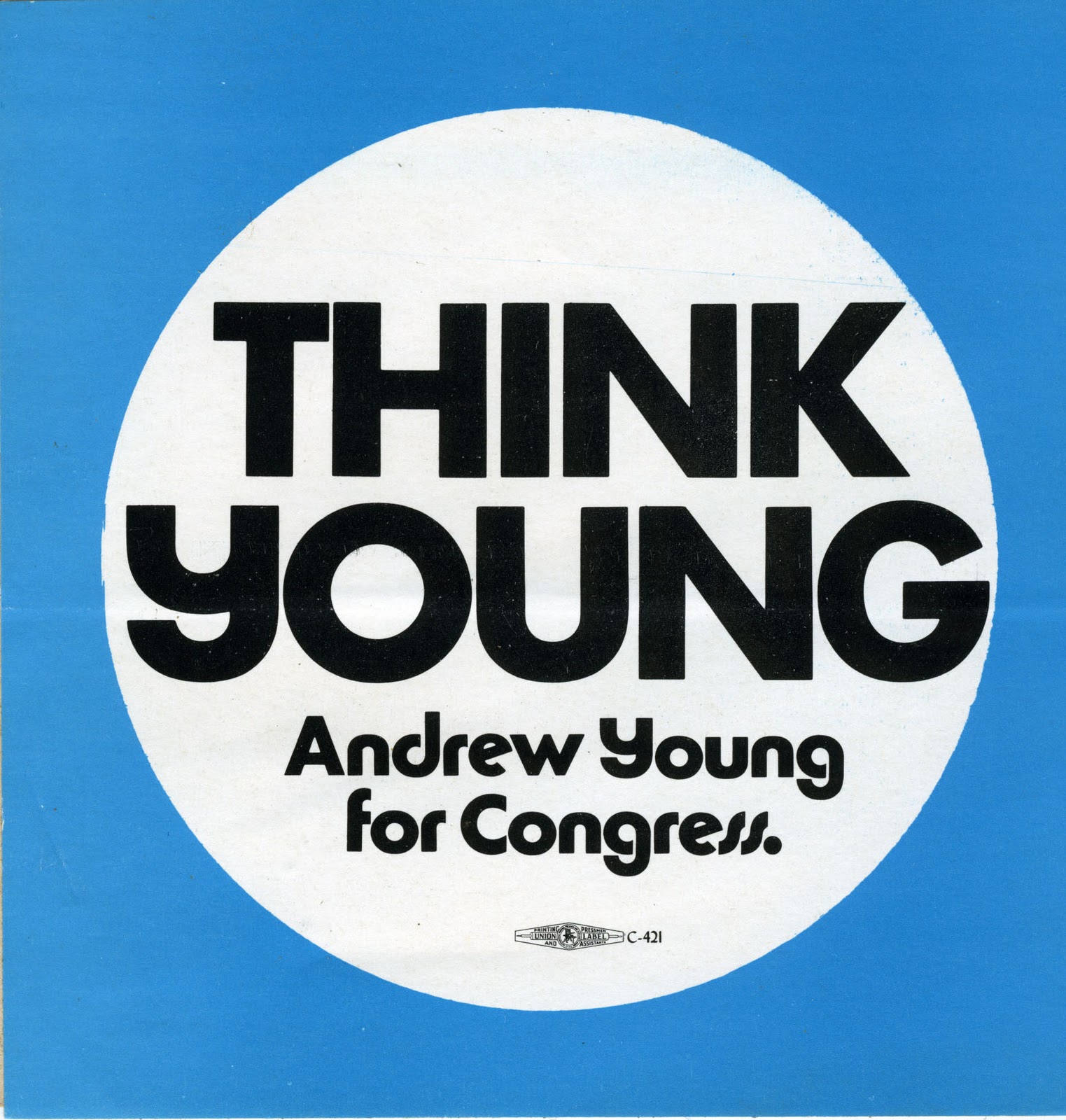
Open for Research: Andrew J. Young Papers + Jean Childs Young Papers


On Sunday, March 06, the Auburn Avenue Research Library celebrated the opening of the Andrew J. Young Papers, as well as those of his first wife Jean Childs Young.  Close to 400 people attended the event, which included a conversation between Ambassador Andrew Young and the Honorable Kasim Reed, Mayor of the City of Atlanta, a display of rare and unique items from the collection, and a catered reception.  It also received widespread media coverage. You can view the event here, listen to a report here, and read about it here, here, here, and here. 

AARL's Adiministrator Francine Henderson, Archivist Kerrie Cotten Williams, and Project Archivist Cheryl Oestreicher were part of the program.  Each spoke eloquently about the importance of public libraries, research libraries, and archives. For Oestreicher, it was an occassion to highlight the experience of working closely with Young's papers. You can read her address below.

 
Comments for Andrew Young Event - .

If you are interested in perusing the finding aids, visit our online finding aids here.

Next up for Oestreicher and team is the Atlanta Chapter of the NAACP records.  Stay tuned.


Posted by Wesley Chenault, Library Research Associate

Friday, March 4, 2011

Research 2.0: Henry Rutherford Butler + Internet + Internet Archive


Archives and technology. It’s difficult to summarize in a post how technology has and continues to radically change research. Suffice it to say we have taken the digital turn, an exhilarating if not dizzying shift. This is a case in point.

Recently Nicole Carmolingo, a former AARL intern, wrote an entry about Henry Rutherford Butler for publication in the New Georgia Encyclopedia. Butler, one of the first African American physicians to establish a practice in Atlanta, lived from 1862 to 1931. While this date range is significant in terms of United States and African American history, one way to view Butler’s life span is through the lens of copyright law. Most of the written traces that document his education, career, and fraternal affiliations are in the public domain, that legal space where technology giants like Google Books thrive, and repositories, including AARL, turn for digitization projects, see here. (Note: AARL holds the Selena Sloan Butler family papers, which include materials related to her husband Henry Rutherford Butler and son Henry Rutherford Butler Jr.)


In addition to traditional research methods, Carmolingo surfed the internet to gather a great deal of biographical information using published secondary sources that are now online. Examples include Daniel Wallace Culp’s Twentieth Century Negro Literature (Or a Cyclopedia of Thought on the Vital Topics Relating to the American Negro, by One Hundred of America's Greatest Negroes), published in 1902, and Edward. R. Carter’s The Black Side: A Partial History of the Business, Religious, and Educational Side of the Negro in Atlanta, Ga. from 1894. My fact checking of her entry, part of the editorial process, also was aided by Google Books and online repositories, such as the Internet Archive. (I credit the Atlanta History Center’s now-defunct blog, Pardon Our Backlog, for the tip.)

In one instance, I needed to verify the name of Butler and colleague Dr. Thomas Heathe Slater’s business, Butler, Slater & Co – the first drug store licensed by the state that was owned by and operated for African Americans. As many researchers know, the Atlanta City Directory, accessible in print form and microfilm, is a go-to resource for information about the city’s people and places. The big news, however, is that some are now digitized; sample a virtual copy of the 1878 volume here. What would have taken a visit to another repository and an hour or more of research to fact check one company name turned into a few minutes of sitting and clicking, thanks to the Internet Archive.


Of course, not everything is or will be digitized. Today’s researchers must balance traditional and contemporary practices to yield the best results. But at this moment in time – when each day holds new online discoveries – technology-enabled changes that facilitate access to the records of our collective past are still something to marvel.

Posted by Wesley Chenault, Library Research Associate

Thursday, February 24, 2011

Research 2.0: Black History Month + Southern Cultures


Researchers take note. Southern Cultures, a quarterly publication of the University of North Carolina’s Center for the Study of the American South, celebrates Black History Month this year with a special and permanent feature you will want to see.

Dave Shaw, the publication's Executive Editor, wrote in an announcement circulated on the H-Net List on Memory Studies :
In celebration of Black History Month, Southern Cultures permanently has dedicated a new section of our website to all of our essays and features from the last decade on AFRICAN AMERICAN HISTORY AND CULTURE. This material includes interviews with many famous figures (and lesser known ones, too), as well as material which explores many aspects of the experiences of African Americans inside and outside the South. In addition, we've also been presenting featured content on our homepage to commemorate African American history: an essay from Timothy B. Tyson, author of Blood Done Sign My Name, who reveals why Martin Luther King's memory endures and what he means to the South and the nation.
To go to Southern Culture’s website, follow this link.

Also in celebration of Black History Month, Rebecca Burns gave an author’s talk last night at AARL about her new book Burial for a King: Martin Luther King Jr.’s Funeral and the Week That Transformed Atlanta and Rocked the Nation. If you get a chance to hear her, do so. You will find more on the Library's other amazing programs here.

Posted by Wesley Chenault, Library Research Associate

Thursday, January 27, 2011

Archives and Publics: Rebecca Burns + "Burial for a King" + Research


On Thursday, February 24, 2011, author and journalist Rebecca Burns will discuss her new book, Burial for a King: Martin Luther King Jr.'s Funeral and the Week that Transformed Atlanta and Rocked the Nation. Read about it here. The event takes place at 7:00 p.m. in the Authors’ and Writers’ Lounge on the 3rd floor and is free and open to the public. If you are in the area, it will be an amazing opportunity to see Burns, as AARL is one of the many research libraries she used to write the book. Copies will be available for purchase.

If you aren’t familiar with Rebecca Burns, spend a few moments here. While well-known as former editor in chief and, now, interactive director at Atlanta magazine, she also is a prolific writer who has published three books in a relatively short amount of time. In addition to Burial for a King, Burns is author of Rage in the Gate City: the Story of the 1906 Atlanta Race Riot, now in its second edition, and Atlanta: Yesterday & Today.

While an accomplished journalist and author, Burns is featured in this post for another reason. She’s an advocate and user of archives. Pick up any of her books, and you will find evidence of exhaustive research through lists of primary and secondary sources, which sometimes include informative notations. I witnessed firsthand the countless hours Burns spent researching AARL collections for Atlanta: Yesterday & Today and Burial for a King; some weeks she worked concurrently on both projects. Throughout months and months of research, Burns exhibited great rigor, thoroughness, and passion.  

The relationship between archivist and researcher is often a collaborative process filled with leads, dead ends, and discoveries. But there’s more to research than this one-to-one relationship. As the editors of Beyond the Archives: Research as Lived Process note, “the process [sic] of research itself creates new knowledge, not just published results” (p. 6). It is generative, transmissive. In other words, those involved in the process are changed as a result of new information and, in turn, change others through intellectual exchange. Examples at hand are an author’s talk or an archivist’s blog post. Both become settings through which findings and information are delivered and meaningful conversations can occur, whether it’s through a question and answer session or comments section.

Please join us Tuesday, February 24th, for what promises to be a wonderful evening of learning and dialogue.


References:

Rebecca Burns, Rage in the Gate City: The Story of the 1906 Atlanta Race Riot, 2nd ed., (Athens, GA: University of Georgia Press, 2009)

_______, Atlanta: Yesterday & Today (Lincolnwood, IL: Publications International, Ltd., 2010)

_______, Burial for a King: Martin Luther King Jr.'s Funeral and the Week that Transformed Atlanta and Rocked the Nation (New York: Scribner, 2011)

Gesa E. Kirsch and Liz Rohan, eds., Beyond Archives: Research as Lived Process (Carbondale, IL: Southern Illinois University Press, 2008)

Posted by Wesley Chenault, Library Research Associate

Wednesday, January 5, 2011

Archives and Publics: J. (Joseph) Richardson Jones Update

This Archives and Publics post provides an update to Dr. Barbara McCaskill and Christina L. Davis's continuing research on J. (Joseph) Richardson Jones.  Pictured below is a revised timeline of Jones's early involvement in radio and vaudeville, which was compiled by Davis based on her research of historic black newspapers. If any blog readers have access to transcription discs or memorabilia from of any of these performances please contact Dr. McCaskill, who's information can be found here.


In addition to the updated timeline, AARL Archives Division is also proud to present a link to the New Georgia Encyclopedia article on J. (Joseph) Richardson Jones, authored by McCaskill and Davis.  See here. The article is proof of the dedication and collaborative spirit they have exhibited through their research, and we congratulate them on its publication!

Posted by Nicole Carmolingo, AARL Archives Intern

Monday, January 3, 2011

Roscoe Conkling Simmons family papers

Pictured above is Anita Martin of the Archives Division as she processes the Roscoe Conkling Simmons family papers. AARL Archives recently acquired the collection and would like to ring in the New Year by giving our blog readers a preview. Roscoe Conkling Simmons (1881-1951) was born in Mississippi and died in Illinois. Simmons was well known during his life as an African American orator, journalist, and political figure. He was a columnist for the Chicago Tribune, making him the first African American columnist working for a daily newspaper in Chicago. His oratorical skills were often employed by the Republican Party, of which he was a devoted member. When needed, the GOP called on Simmons to marshal black votes to support its causes. He was also the nephew of Booker T. Washington, whose third wife was his aunt. He married Althea Merchant Simmons and had three sons, William Murray Simmons, Thomas Murray Simmons, and Roscoe Conkling Simmons Jr (by a former marriage).

The Roscoe Conkling Simmons family papers consist of a variety of documents and materials. One of the largest segments of the collection is the correspondence, which contains approximately 645 letters, cards and telegrams. Many of the letters were authored by William and Thomas and sent to their mother, Althea, between 1952-1962. Coinciding with the Civil Rights Movement, they were written while the sons were at college and when William served as a captain in the United States Air Force. Another significant portion of the collection is the approximately 600 photographs, which date from the 1860s through the 1950s. About 100 of the photos document Althea’s college years at the University of Illinois. In addition to the many photographs and letters, the Roscoe Conkling Simmons family papers also contain eight books from his personal library, thirty pieces of historical ephemera, a 1916 diary written by Althea during her freshman year of college, as well as a painting of her.

The Archives Division is very excited about the opportunities this collection will offer researchers and historians. While it's currently unavailable for use, the Division hopes to announce its opening very soon. Those interested should note that the Harvard University Archives also has a Roscoe Conkling Simmons collection.

References:

Boulware, Marcus H. The Oratory of Negro Leaders, 1900-1968. Negro Universities Press, 1969.

Lentz-Smith, Adriane Dannette. Freedom Struggles: African Americans and World War I. Harvard University Press, 2009.

Posted by Nicole Carmolingo, AARL Archives Intern

Tuesday, December 21, 2010

Merry Christmas!

Today’s post features six holiday cards from the Selena Sloan Butler Family papers. Selena and Henry R. Butler were both equally involved in the Atlanta community through professional and civic endeavors. Henry was one of the first African American physicians to establish a permanent medical practice in the Atlanta area upon moving here in 1890. In addition, he was involved in local chapters of the Prince Hall Freemasons, Sigma Pi Phi fraternity, and Omega Psi Phi fraternity. Selena played a crucial role in the establishment of both the Georgia Congress of Colored Parents and Teachers and the National Congress of Colored Parents and Teachers (NCCPT). The Butlers were also involved in the creation of the Georgia Commission of Interracial Cooperation, as well as members of Big Bethel A.M.E Church. The cards pictured here were sent to the Butler family during the 1941 holiday season.
 

Posted by Nicole Carmolingo, AARL Archives Intern