Showing posts with label processing. Show all posts

Tuesday, June 12, 2012

Documenting Sports: 100% Wrong Club of Atlanta


Mrs. Margaret Jacobs donated the historical records of the 100% Wrong Club to the Auburn Avenue Research Library. The majority of the records were collected by her late husband, Joseph H. Jacobs, a member of the club.  Established in 1934 by the Sports Department of the Atlanta Daily World, the club’s members surveyed college teams and athletes for recognition and awards. The club has expanded its scope by continuing to recognize and award college and high school athletes, local community leaders, and national pioneers in the field of sports and social justice. Each year, after the college bowl games, the club selects college and high school student athletes to attend the annual "Sports Jamboree" weekend. The collection includes photographs, minutes, news clippings, correspondence and ephemera.

The collection is now available for use:   http://aafa.galileo.usg.edu/aafa/view?docId=ead/aarl0011-007-ead.xml;query=wrong;brand=default

Posted by Kerrie Cotten Williams, Archivist and Manager of the AARL Archives Division

Friday, June 8, 2012

Meet Our New AARL Archives Intern for Summer 2012


The AARL Archives Division hosts graduate interns who desire practical experience in special collections.  This year we have another dynamic student, Jessica Perkins Smith.  I asked her a few questions about her background and interests...

KCW:  What is your academic institution?

JPS:  Louisiana State University School of Library and Information Science.  I will graduate in December '12 with an MLIS, with an archives focus.

KCW:  Why did you select AARL as an internship site?

JPS:  I have a history and archival research background, and the Civil Rights movement has always been my main area of interest. Interning at Auburn Avenue is allowing me to work with collections that interest me, but I also knew that I would learn from the archivist here by getting great hands on experience in processing, writing finding aids, and helping researchers.

KCW:  What is your internship assignment/project?

JPS:  I am currently working on processing the papers of Atlanta attorney Donald L. Hollowell. Hollowell was instrumental in several prominent Civil Rights cases in Atlanta and throughout Georgia.

KCW:  What is the most interesting item you've handled?

JPS:  Hollowell represented Preston Cobb, the 15 year old African American teen convicted and sentenced to death for killing a white man in 1961 in Georgia. Hollowell succeeded in getting Cobb's execution stayed and, eventually his death sentence was commuted and Cobb served 18 years in prison. In processing Hollowell's papers I found correspondence between Hollowell and a Baltimore businessman, Abe Blumenthal, who had taken an interest in Preston Cobb's case and wanted to help. Blumenthal wanted to help Cobb continue his education while in prison and helped by sending money and writing Cobb letters.

Posted by Kerrie Cotten Williams, Archivist and Manager of the AARL Archives Division

Wednesday, June 22, 2011

The Final Touches: Opening a Collection for Use


For an archivist, one of the most satisfying moments before a collection officially opens to researchers is affixing labels to boxes. In terms of the tasks associated with processing, there is no more to do. All arrangement and description is complete. All folders are labeled. All extraneous bits and boxes have a home. Everything is in its final place.

Pictured above, AARL Intern Nicole Carmolingo attaches the last label to the Shirlene Holmes papers, which opens soon, after final revisions are made to the finding aid. Details about the collection will accompany the announcement posted here. For now, Nicole has a deserved happy moment for processing, arranging, and describing 35.19 linear feet of materials comprising 50 boxes and 5 oversize boxes.

Posted by Wesley Chenault, Library Research Associate

Thursday, January 20, 2011

The Opening of the Andrew J. Young Papers

SAVE THE DATE!

On Sunday, March 6, the Auburn Avenue Research Library will host an event to celebrate the opening of the Andrew J. Young Papers.

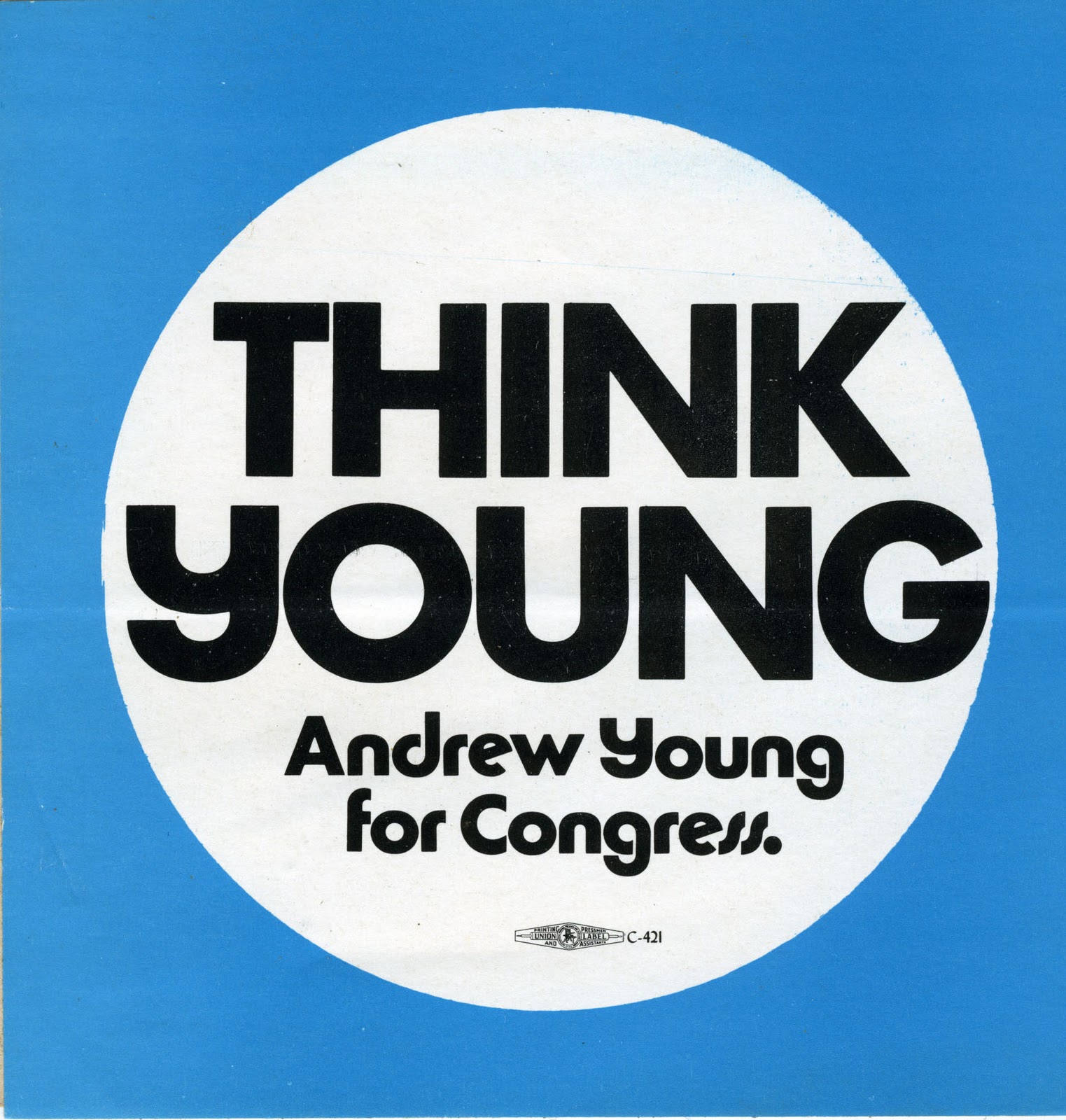
In 2009, the archives received a grant from the Council on Library and Information Resources to process the collection. It documents the various aspects of his career and family life spanning more than 50 years, including his positions as a minister, civil rights activist, Congressman, Ambassador to the United Nations, Mayor of Atlanta, Co-Chair of the 1996 Atlanta Committee of the Olympic Games, and his involvement with Law Companies Group, Inc. and GoodWorks International.

The collection contains correspondence, speeches, press releases, calendars, books, minutes, reports, publications, articles, photographs, artifacts, textiles, trophies and awards, artwork, posters, programs, invitations, campaign memorabilia, manuscripts, travel documents, notes, sermons, ephemera, and audio-visual material.

More details to come soon. We hope you can join us to celebrate this momentous occasion!

Posted by Cheryl Oestreicher, Project Archivist

Monday, January 3, 2011

Roscoe Conkling Simmons family papers

Pictured above is Anita Martin of the Archives Division as she processes the Roscoe Conkling Simmons family papers. AARL Archives recently acquired the collection and would like to ring in the New Year by giving our blog readers a preview. Roscoe Conkling Simmons (1881-1951) was born in Mississippi and died in Illinois. Simmons was well known during his life as an African American orator, journalist, and political figure. He was a columnist for the Chicago Tribune, making him the first African American columnist working for a daily newspaper in Chicago. His oratorical skills were often employed by the Republican Party, of which he was a devoted member. When needed, the GOP called on Simmons to marshal black votes to support its causes. He was also the nephew of Booker T. Washington, whose third wife was his aunt. He married Althea Merchant Simmons and had three sons, William Murray Simmons, Thomas Murray Simmons, and Roscoe Conkling Simmons Jr (by a former marriage).

The Roscoe Conkling Simmons family papers consist of a variety of documents and materials. One of the largest segments of the collection is the correspondence, which contains approximately 645 letters, cards and telegrams. Many of the letters were authored by William and Thomas and sent to their mother, Althea, between 1952-1962. Coinciding with the Civil Rights Movement, they were written while the sons were at college and when William served as a captain in the United States Air Force. Another significant portion of the collection is the approximately 600 photographs, which date from the 1860s through the 1950s. About 100 of the photos document Althea’s college years at the University of Illinois. In addition to the many photographs and letters, the Roscoe Conkling Simmons family papers also contain eight books from his personal library, thirty pieces of historical ephemera, a 1916 diary written by Althea during her freshman year of college, as well as a painting of her.

The Archives Division is very excited about the opportunities this collection will offer researchers and historians. While it's currently unavailable for use, the Division hopes to announce its opening very soon. Those interested should note that the Harvard University Archives also has a Roscoe Conkling Simmons collection.

References:

Boulware, Marcus H. The Oratory of Negro Leaders, 1900-1968. Negro Universities Press, 1969.

Lentz-Smith, Adriane Dannette. Freedom Struggles: African Americans and World War I. Harvard University Press, 2009.

Posted by Nicole Carmolingo, AARL Archives Intern

Wednesday, December 8, 2010

Archives and Publics: Andrew J. Young + Photograph Identification

The Andrew J. Young Papers contain nearly 40,000 photographs and slides that document Young’s family, life, and work spanning more than 50 years. There are photos of Young, his children, and his grandchildren as babies; his first ministerial post in the mid-1950s through weddings he performed in the 1990s; the SCLC Citizenship School through his GoodWorks activities; his first Congressional campaign in 1970 through his 1990 gubernatorial campaign; his Ambassadorial trips across the globe through bidding for the Olympics through tropical vacations; and everything in between.  (Below: Ambassador Andrew Young is pictured in his Waldorf-Astoria residence, late 1970s.)


Many prominent people appear in the photographs, including Jimmy and Rosalynn Carter, RUN-DMC, Oprah Winfrey, Maya Angelou, Hank and Billye Aaron, Martin Luther and Coretta Scott King Jr., Jesse Jackson, Bill Cosby, Sidney Poitier, Garth Brooks, Harry Belafonte, Cornel West, Muhammad Ali, George Bush Jr. and Sr., Bill and Hillary Clinton, Mikhail Gorbachev, Billy Graham, Rosa Parks, Mother Theresa, Nelson Mandela, Desmond Tutu, and Ted Turner and Jane Fonda. There are also many prominent Atlantans, such as Shirley Franklin, Sue Ross, Julian Bond, Hosea Williams, Jesse Hill, Joseph Lowery, Ralph Abernathy, Marvin Arrington, Zell Miller, Benjamin E. Mays, Bernard Scott Lee, Bill Campbell, and Maynard Jackson. (Below: Andrew Young, seated, identifies photographs for project staff, pictured left to right, Brenda Tindal, Mike Kaiser, and Cheryl Oestreicher.)


While the majority of the photographs were labeled or identifiable, many were not. On Tuesday, Andrew Young and his daughter Andrea visited the archives and helped identify the people, places, and events. Their assistance was invaluable as it not only helps us to organize the images, but will ease researchers’ use of the collection. As we documented what they said, we listened to their reminiscences about the people, the places, the events, and their lives. (Below: Pictured left to right are Mike Kaiser, Cheryl Oestreicher, and Andrew Young.)


Near the end of his time in the archives, he reflected, “We’ve really had a good life.”

For more information about the grant-funded project to process the Young papers and other civil rights related collections, see the CLIR Hidden Collections Grant blog.

Posted by Cheryl Oestreicher, Project Archivist

[The Andrew J. Young Papers at AARL are closed for processing and expect to be open in March 2011]

Tuesday, October 26, 2010

Treasures from the Vertical Files: Salesman of Death

Today’s treasure offers the opportunity for some Halloween themed fun, as well as a discussion of ephemera identification in archival processing. Pictured here is a business card of Mr. G.W. Durham, a funeral director in Campbellsville, Kentucky. One side of the card gives an interesting description of Durham’s professional expertise along with his picture and contact information, while the other lists costs and services.

In addition to aligning with the theme of death often associated with Halloween, this business card also presents the subject of ephemera identification. When processing archival collections, archivists come across a variety of materials, some which are known as ephemera. According to the Society of American Archivists, ephemera is defined as “materials, usually printed documents, created for a specific, limited purpose, and generally designed to be discarded after use.” Examples of different types of ephemera include brochures, event tickets, and advertisements.

When organizing a collection, it is necessary for an archivist to identify different types of ephemera for labeling purposes and in order to better assist researchers. However, some, including Durham’s business card, are not easily identifiable compared with modern formats. His cards fit into the category of personal cards, which Chris E. Makepeace, author of Ephemera: A Book on Its Collection, Conservation and Use, says includes visiting cards, identity cards and business cards. But they do not conform exactly to the qualifications of current day business cards and may have been called by a different title during the period used.

While the exact identifying term of Durham’s card may be unknown at this time, it is still a valuable tool for researchers. The information printed on personal cards – names, addresses, telephone numbers, professions, and even business details – might not be available otherwise, making this type of ephemera historically significant. Personal cards allow researchers to learn about individuals and businesses and are helpful for genealogical research. They may seem like things to be thrown away but are useful, important forms of documentation.

References:

Makepeace, Chris E. Ephemera: A Book on Its Collection, Conservation and Use. Vermont: Gower Publishing Company, 1985.

Moses, Richard Pearce. A Glossary of Archival and Records Terminology. The Society of American Archivists. http://www.archivists.org/glossary/index.asp

Rickards, Maurice and Michael Twyman. Encyclopedia of Ephemera: A Guide to the Fragmentary Documents of Everyday Life for the Collector, Curator and Historian. Routledge: New York, 2000.

Posted by Nicole Carmolingo, AARL Archives Intern

Tuesday, July 20, 2010

The Life and Letters of James Bryant Smith


As part of the Advanced Archives Practicum class offered by the University of West Georgia's Public History Program, we are required to complete seventy-five internship hours for Auburn Avenue Research Library. Our first group project was to process the James Bryant Smith Collection, which details the life of the Tuskegee Airman from Columbus, Ohio.


A war veteran and POW, Smith’s collection contains over 750 letters to and from his wife, Florence Smith. The majority of the letters date from 1943 and 1944, when Smith left Columbus to become one of the first airmen to complete aviation training at Tuskegee Air Field. Several significant personal events are recorded in these early letters, from James and Florence’s engagement and marriage to the birth of their first child. The Smiths also corresponded about their day-to-day activities, which included his flight training and her work at an Ohio airplane assembly plant.


Smith arrived at the Tuskegee Air Field in Alabama in January 1943 and trained as a fighter pilot with the 1155th Single Engine Flying Training Squadron (S.E.F.T.S.). Smith remained a career serviceman after World War II ended, and he served in various training capacities in Hawaii and Colorado. When the Korean War began in 1950, Smith’s unit was quickly shipped out. On September 8th his family received notice that he had been missing in action since July 26th. During this time, for approximately three months, Smith was a Prisoner of War.


As a Tuskegee Airman, Smith was in a unique position to help improve race relations within the nation. Prior to the Tuskegee Airmen, no African Americans had been military pilots, and the War Department was so resistant of the notion that it attempted to eliminate the unit before it could even begin. Only those with a certain level of flight experience or higher education could apply, but it underestimated the number of eligible men who would apply. James and Florence discussed other racially-charged events, such as the Detroit Race Riots in June 1943, as well as every-day discrimination, like the segregation of train cars.

In addition to James and Florence Smith’s correspondence during World War II, the collection also highlights Smith’s subsequent military career. Smith saved many documents, publications, and artifacts from his service in the 1950s and 1960s, which would be of great interest to military enthusiasts.

Posted by Shannon Danielle Smith and Sarah Warren, University of West Georgia interns

Wednesday, July 7, 2010

Mary Parks Washington Papers

One of the jobs that archivists do is process collections. When collections arrive at the archives, they are often unorganized or organized in a way that only makes sense to the creator of the collection. In addition, an archivist may need to treat preservation issues such as mold, acidic paper (for example, brittle, yellowed newspaper), or damaging adhesives. During processing, archivists arrange, preserve, and describe collections so that they are accessible to users.

This summer, I’ve been working on processing the papers of Mary Parks Washington, an Atlanta-born visual artist, arts educator, and arts advocate. Washington uses the art forms of drawing, painting, sculpture, and collage to explore themes of history and memory. She also developed a unique collage form which she calls “histcollage,” an assemblage of old documents (such as family photos, insurance policies, and letters) that she incorporates into her drawings and paintings.

As a young woman, Washington had several experiences that helped nurture her talents and love of the arts. Washington exhibited her artwork while she was still in high school at Atlanta’s Booker T. Washington High. The artist Hale Woodruff, a professor at Spelman College, was one of the judges and continued to mentor her when she attended Spelman to study art.

After her graduation from Spelman in 1946, Woodruff helped Washington receive a scholarship from the Rosenwald Fund to attend the Summer Art Institute at the experimental Black Mountain College in North Carolina. Washington’s experience at Black Mountain was a contrast to her life and schooling in Atlanta. In addition to being at a racially integrated institution, classes were informal with students often spreading their work on the floor to be critiqued by their instructors. Washington bought a pair of “dungarees” especially for the relaxed atmosphere since she had never before worn pants. At Black Mountain Washington studied with several renowned artists including Josef Albers, Jean Varda, Beaumont Newhall, and Gwendolyn Knight. It was at Black Mountain that Washington developed lifelong friendships with Knight, her husband artist Jacob Lawrence, and sculptor Ruth Asawa, who was one of her roommates.

Following her summer at Black Mountain, Washington began her career as a teacher at David T. Howard High School. In 1947, Washington once again used her summer vacation to study art, this time at the University of Mexico. In order to forestall desegregation attempts in higher education, the State of Georgia paid the out-of-state tuition for African American students. Using Georgia’s segregationist policies to her advantage, Washington was the first person to receive out-of-country tuition from Georgia. Her histcollage Georgia Out-of-State Tuition explores this experience.The Mary Parks Washington Papers document these events as well as Washington’s career as an arts educator, her friendships with artists; her role as arts advocate, and her participation in civic and community service organizations.

Photo credits: Mary Parks Washington at Black Mountain College,1946, Photographer: Beaumont Newhall. Marriage License and Georgia Out-of-State Tuition, excerpted from Atlanta: Remembrances, Impressions and Reflections, 1996 © Mary Parks Washington, Photographers: James Devrances & John Bremons

Posted by Krystal Appiah, Archives Intern